


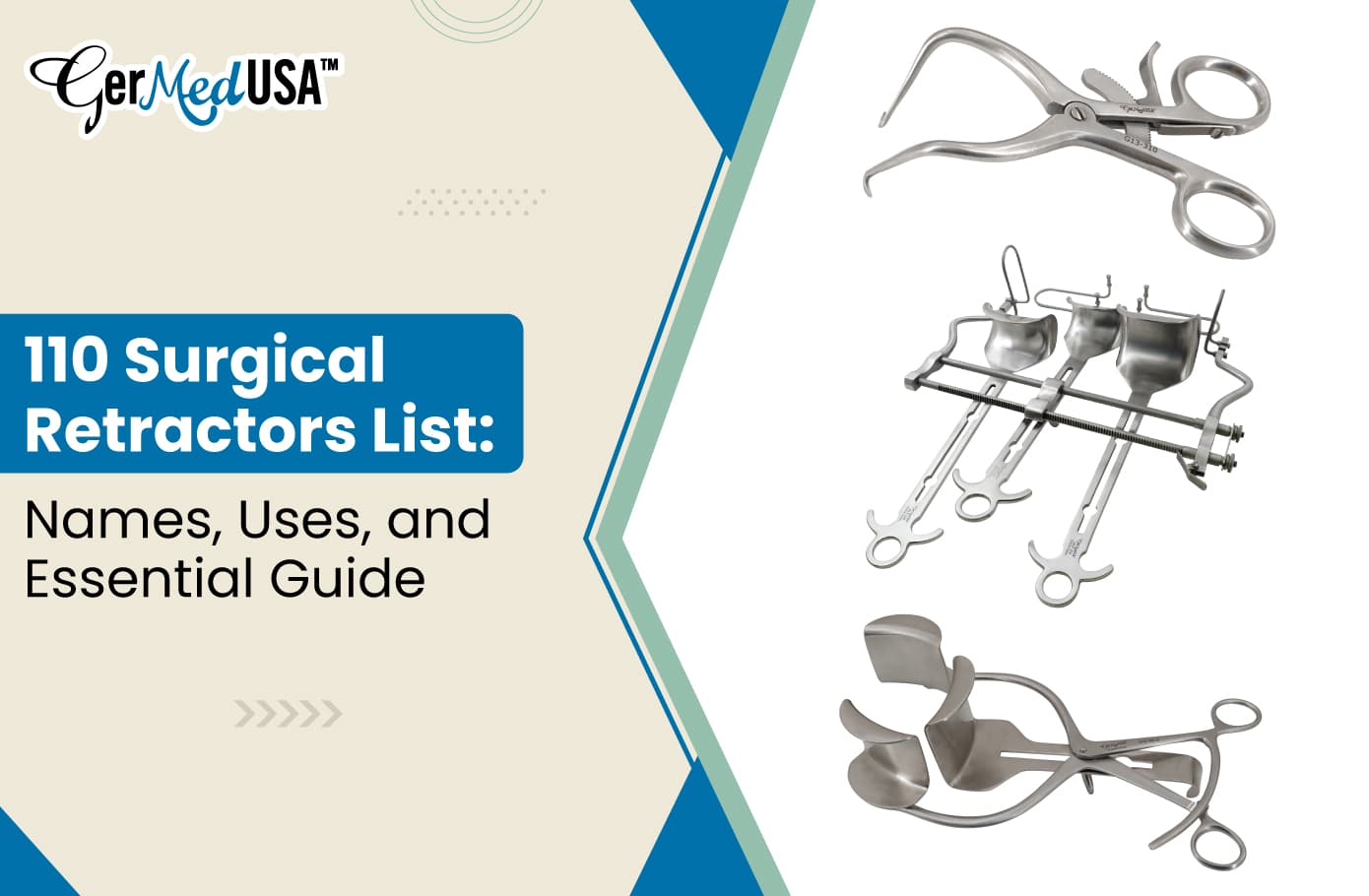
Surgical retractors are key instruments in operating rooms. They are used to hold back tissues and provide access to underlying structures during surgical procedures.
They are applied across multiple fields, including general surgery, orthopedics, gynecology, and veterinary practice, supporting better visibility of the surgical site.
In this article, we present a detailed list of surgical retractors with names and uses, along with their features and how they support surgical care in different procedures.
Why Every Surgical Setup Needs a Complete Range of Retractors?
Human body anatomy is layered. Skin covers muscle, muscle covers fat, fat covers organs, and everything sits close together. When a surgeon makes an incision, the surrounding tissue naturally wants to fall back into the original position. Without retractors, the surgical site would close in, block the view, and make precise work nearly impossible.
Surgical retractors hold back tissue, skin, and organs so the medical team can work safely and accurately.
Surgical retractors also support the surgery by:
• Keeping the wound open so the surgeon has a clear and consistent view throughout the procedure.
• Protecting surrounding structures by gently holding tissue away from instruments and reducing accidental injury.
• Reducing the need for extra hands since self-retaining retractors hold themselves in place without requiring a team member to hold them manually.
• Improving surgical accuracy by giving the surgeon full control over what is exposed and what is protected.
In short, no retractor means no visibility. No visibility means no safe surgery. These instruments are not optional tools; they are foundational to modern surgical practice.
Below is a complete surgical retractor list for better understanding.
A Detailed Table of 110 Must-Have Retractor Instruments
A comprehensive list of retractor surgical instruments with their primary clinical uses.
| No. | Instrument Name | Uses |
| 1 | O'Sullivan O'Connor Abdominal Retractor Complete | Used in pelvic and abdominal surgeries to retract the abdominal wall and maintain clear surgical exposure. |
| 2 | Collin Abdominal Retractor Two Swivel Blades 9" | Used to hold back the abdominal walls during open abdominal procedures for improved visibility. |
| 3 | Franz Abdominal Retractor Eight Blades Folds For Easy Storage | Used in abdominal surgeries to retract tissues with multiple blade options for adjustable exposure. |
| 4 | Gosset Abdominal Retractor | Used as a self-retaining retractor to hold abdominal incisions open during laparotomy procedures. |
| 5 | Fritsch Abdominal Retractor 9 1/2" | Used to retract the abdominal wall and expose deeper structures during general surgical procedures. |
| 6 | Balfour Abdominal Retractor Standard (Without Ratchet) | Used to keep the abdominal cavity open during laparotomy without a ratchet locking mechanism. |
| 7 | Balfour Abdominal Retractors with Ratchet | Used to maintain abdominal exposure during surgery with a ratchet for secure self-retention. |
| 8 | Ricard Abdominal Retractor Spreader With 3 Blades | Used to spread and retract the abdominal walls with three interchangeable blades for varied exposure. |
| 9 | Balfour Center Retractor Blade | Used as a center blade attachment with the Balfour retractor to hold the bladder or bowel aside. |
| 10 | Luer S Retractor Double Ended | Used to retract soft tissues during orthopedic and general surgical procedures with two working ends. |
| 11 | Balfour Abdominal Retractor Spread Light Pattern | Used to retract the abdominal cavity with a lightweight design suited for less invasive procedures. |
| 12 | Halo Retractor | Used to provide circular self-retaining retraction around an incision site for improved exposure. |
| 13 | Stay Blunt/Sharp Hooks | Used to retract skin and soft tissues with blunt or sharp hook tips during minor surgical procedures. |
| 14 | Rake And Blade Hooks | Used to retract skin edges and underlying tissue layers during superficial surgical exposure. |
| 15 | Beckman Eaton Laminectomy Retractor Hinged Sharp 7x7 Teeth 1 3/4" Wide X 2" Deep Size 12 3/4" | Used in laminectomy procedures to retract deep paraspinal tissues with hinged sharp prongs. |
| 16 | Beckman Weitlaner Retractor Sharp | Used as a self-retaining retractor with sharp prongs to hold tissues apart during deep dissection. |
| 17 | Beckman Retractor 12 1/2" | Used in orthopedic and general surgeries to provide self-retaining tissue retraction. |
| 18 | Beckman Weitlaner Retractor Blunt | Used as a self-retaining retractor with blunt prongs for delicate soft tissue retraction. |
| 19 | Judd Masson Retractor | Used to retract tissues with a wide blade design during abdominal and pelvic surgeries. |
| 20 | Blair Flexible Shank Retractors 6 1/4" | Used to retract soft tissues with a flexible shank that can be bent to fit the anatomy. |
| 21 | Israel Retractor 9" | Used as a rake retractor to hold back muscle and soft tissue during orthopedic procedures. |
| 22 | Allison Lung Retractor 12 3/4" | Used in thoracic surgeries to gently retract lung tissue and expose underlying structures. |
| 23 | Deaver Retractors Plain Handle | Used to retract deep abdominal organs such as the liver during major abdominal surgeries. |
| 24 | Deaver Retractors Hollow Grip Handle | Used to retract deep tissues with a lightweight hollow handle for surgeon comfort. |
| 25 | Pediatric Deaver Retractors | Used to retract abdominal organs in pediatric surgical procedures with smaller blade sizes. |
| 26 | Desmarres Lid Retractors 5 1/2" | Used in ophthalmic procedures to retract the eyelid and expose the conjunctiva and globe. |
| 27 | Lacrimal Sac Retractor | Used in lacrimal surgery to retract surrounding tissue and expose the lacrimal sac. |
| 28 | Mcgannon Iris Retractor 5 1/4" Fenestrated Hook Tip 2.5mm | Used during cataract and iris surgeries to retract the iris with a fenestrated hook tip. |
| 29 | Flexible Neck Rake Retractor 6" | Used to retract tissues during neck surgery with a flexible neck for adjustable positioning. |
| 30 | Allport Retractor 2 1/2" Spread 4x4 Sharp 4" | Used as a self-retaining retractor in mastoid and ear surgeries for sharp tissue retraction. |
| 31 | Crile Retractor 4 1/2" Double Ended | Used to retract small skin and soft tissue flaps in minor surgical procedures. |
| 32 | Parker Mott Retractor 6" Double Ended Set of 2 | Used to retract skin and superficial tissues during general surgical procedures. |
| 33 | Rigby Appendectomy Retractor With Grip Lock 6 3/4" | Used during appendectomy procedures to provide self-retaining retraction with a grip lock. |
| 34 | Frazier Retractor 3 1/4" Spread 3X4 Blunt | Used as a self-retaining retractor with blunt prongs for shallow surgical exposure. |
| 35 | Mayo Collins Retractor 6" Double Ended Set of 2 | Used to retract soft tissues during general and abdominal surgeries with two working ends. |
| 36 | Heaney Simon Retractor 11 1/2" Blade 1" x 4 1/2" | Used in vaginal hysterectomy procedures to retract the vaginal walls and expose the surgical site. |
| 37 | Green Thyroid Retractor 8 1/2" | Used in thyroid surgeries to retract tissues and expose the thyroid gland. |
| 38 | Goelet Retractor 7 1/2" Double Ended | Used to retract skin and soft tissues during orthopedic and general surgical procedures. |
| 39 | Lahey Thyroid Retractor 7 1/2" | Used in thyroidectomy procedures to retract muscle and tissue around the thyroid gland. |
| 40 | Farabeuf Retractor Double Ended | Used to retract skin, muscle, and soft tissues during general surgical and orthopedic procedures. |
| 41 | Parker Retractor Double Ended Blade | Used to retract small incisions and soft tissues with two differently sized working ends. |
| 42 | Roux Retractor Double Ended | Used to retract small incisions during minor surgical procedures with two blade sizes. |
| 43 | Langenbeck Retractors 8" Hollow Handle | Used to retract soft tissues and muscle during general and orthopedic surgeries. |
| 44 | Gallbladder Retractor | Used in cholecystectomy procedures to retract surrounding tissues and expose the gallbladder. |
| 45 | Mayo Adams Retractor 6 3/4" | Used as a self-retaining retractor for holding tissues apart during minor surgical procedures. |
| 46 | Mathieu Retractor 6 1/2" Double Ended | Used to retract soft tissues during dental and oral surgical procedures. |
| 47 | Hibbs Retractors | Used in orthopedic procedures to retract muscle and soft tissue for spinal and bone exposure. |
| 48 | Cushing Vein Retractor | Used in neurosurgical procedures to gently retract veins and delicate tissues. |
| 49 | Heaney Retractor 10" | Used in vaginal hysterectomy procedures to retract the vaginal wall for improved access. |
| 50 | Bellucci Endaural Retractors 4 1/4" | Used in ear surgeries to retract tissues within the ear canal for clearer visualization. |
| 51 | Army Retractors | Used to retract skin and soft tissues during general surgical and orthopedic procedures. |
| 52 | Henner Endaural Retractor 4 3/4" | Used in endaural ear surgeries to maintain retraction within the ear canal. |
| 53 | Bennett Bone Elevator and Retractors 9 1/2" | Used in orthopedic procedures to elevate and retract muscle and soft tissue from bone. |
| 54 | Doyen Vaginal Retractor 9" | Used in obstetric and gynecological procedures to retract the vaginal wall during surgery. |
| 55 | Sims Vaginal Retractor Grip Handle | Used in gynecological exams and procedures to retract the vaginal walls with a grip handle. |
| 56 | Kelly Vaginal Retractor Grip Handle | Used to retract the vaginal walls during gynecological exams with a comfortable grip handle. |
| 57 | Sims Vaginal Retractor Single Ended | Used in vaginal exams and procedures to retract one wall of the vagina for clearer access. |
| 58 | Sims Vaginal Retractor Double Ended | Used to retract the vaginal walls with two differently sized blades for varied exposure. |
| 59 | Jackson Vaginal Retractor 7" | Used in gynecological procedures to retract the vaginal wall for improved surgical access. |
| 60 | Redundant Wall Retractor 7 3/4" | Used to retract redundant vaginal wall tissue during gynecological procedures. |
| 61 | Eastman Vaginal Retractor 7" | Used in gynecological surgeries to retract the vaginal walls for improved exposure. |
| 62 | Lateral Vaginal Retractor | Used to retract the lateral walls of the vagina during gynecological exams and procedures. |
| 63 | LEEP/LLETZ Redundant Wall Vaginal Retractor | Used in LEEP and LLETZ procedures to retract redundant vaginal wall tissue away from the cervix. |
| 64 | De Lee Universal Retractor 9 1/2" Blade 2 3/4" x 2" | Used in obstetric and gynecological surgeries to retract tissues with a broad universal blade. |
| 65 | Kelly Retractor 10" Hollow Grip Handle | Used to retract tissues during abdominal and gynecological procedures with a hollow grip handle. |
| 66 | Kelly Retractor 9 3/4" Loop Handle | Used to retract tissues during surgery with a loop handle for secure finger grip. |
| 67 | Knapp Retractor 5 1/4" | Used in ophthalmic and delicate surgeries to retract small tissues with precision. |
| 68 | Lahey Retractor 4 3/4" | Used to retract tissues during thyroid and small surgical procedures. |
| 69 | Ribbon Retractors Malleable | Used to retract soft tissues with a malleable blade that can be bent to fit the anatomy. |
| 70 | Meyerding Self Retaining Retractor 7" | Used in laminectomy and orthopedic procedures to self-retain retraction of muscle and tissue. |
| 71 | Meyerding Finger Retractor 7" | Used in hand and finger surgeries to retract small soft tissues for clear visualization. |
| 72 | Meyerding Retractor | Used in spinal and orthopedic procedures to retract deep muscle and tissue layers. |
| 73 | Meyerding Skin Hook and Retractor 6 1/4" Double Ended Blade 5.0mm x 16.0mm 1 Sharp Prong | Used to retract skin edges and soft tissues with a sharp prong on one end and a blade on the other. |
| 74 | Hurd Tonsil Dissector and Pillar Retractor 8 3/4" | Used in tonsillectomy procedures to dissect and retract tonsillar pillars. |
| 75 | Love Uvula Retractor 6 3/4" | Used in oral and pharyngeal surgeries to retract the uvula and improve surgical access. |
| 76 | Tracheal Retractor 6 1/2" | Used in tracheostomy and airway procedures to retract tissues and expose the trachea. |
| 77 | Jackson Tracheal Retractor | Used during tracheal surgery to retract surrounding tissues and expose the airway. |
| 78 | Lothrop Uvula Retractor 6 3/4" Angled Shaft 20mm Wide Blade | Used in pharyngeal procedures to retract the uvula with an angled shaft for improved access. |
| 79 | Hupp Tracheal Retractor 6" Double Ended 3 Prongs and Hook | Used in tracheal surgery to retract tissues with three prongs on one end and a hook on the other. |
| 80 | Murphy Rake Retractor 7 1/2" | Used to retract skin and soft tissue with rake-style prongs in general surgical procedures. |
| 81 | Cottle Ball End Retractor 6 1/2" Two Ball Prongs | Used in rhinoplasty and nasal surgery to retract tissues gently with rounded ball-tip prongs. |
| 82 | Cottle Joseph Retractor 5 1/2" Two Sharp Prongs 12mm Wide | Used in nasal and plastic surgery to retract tissues with two sharp prongs. |
| 83 | Love Nerve Retractor 8 1/2" | Used in neurosurgical procedures to gently retract nerves without causing damage. |
| 84 | Davis Scalp Retractor 3x3 Blunt Prongs 10mm Deep Size 4 1/2" | Used in scalp and cranial procedures to retract tissues with blunt prongs. |
| 85 | Jansen Wagner Retractor 5x5 Sharp Prongs Self Adjusting Size 5" | Used as a self-retaining retractor with sharp prongs during dental and oral surgical procedures. |
| 86 | Cushing Decompression Retractor 8 1/2" Fenestrated Blade 12mm Angled | Used in neurosurgical decompression procedures to retract tissues with a fenestrated angled blade. |
| 87 | Rollet Retractor 5" | Used to retract skin and superficial tissues during minor surgical procedures. |
| 88 | Aufricht Nasal Retractor Speculum Solid Blade 45mm 6 1/2" | Used in rhinoplasty to retract the nasal dorsum and expose the underlying bone and cartilage. |
| 89 | Cottle Knife Guide and Retractor Double Ended 8" | Used in nasal surgery to guide knife incisions and retract tissue with two working ends. |
| 90 | Nievert Knife Guide and Retractor Double Ended 6 1/2" | Used in nasal procedures to guide blade incisions while retracting surrounding tissue. |
| 91 | Converse Alar Retractor 4" Double Ended Blunt 10mm and 14mm | Used in rhinoplasty to retract the alar cartilage with blunt ends of two different sizes. |
| 92 | Ragnell Retractor 6" Double Ended | Used in plastic and reconstructive surgeries to retract delicate soft tissues. |
| 93 | Smith (Buie) Anal Retractor | Used in proctology and anorectal procedures to retract the anal canal for surgical exposure. |
| 94 | Barr Anal Retractor Self retaining Blades 8" 2 3/4" X 7/8" | Used as a self-retaining retractor in anorectal surgeries to maintain anal canal exposure. |
| 95 | Rectal Retractor with Attachments | Used in rectal procedures to retract tissues with interchangeable blade attachments. |
| 96 | Richardson Eastman Retractors 10" Double Ended Set of 2 | Used to retract abdominal walls and deep tissues with two working ends for varied depths. |
| 97 | Richardson Retractor 9 1/2" Loop Handle | Used in abdominal surgeries to retract deep tissues with a comfortable loop handle. |
| 98 | Richardson Retractor Hollow Grip Handle | Used to retract abdominal tissues with a lightweight hollow grip handle for surgeon comfort. |
| 99 | Rigid Neck Rake Retractor 6" | Used to retract tissues during neck procedures with a rigid neck for stable positioning. |
| 100 | Young Prostatic Retractor | Used in prostate surgeries to retract surrounding tissues and expose the prostate gland. |
| 101 | Volkman Retractor 8 1/2" | Used to retract skin and soft tissue with rake-style prongs in general surgery. |
| 102 | Volkman Retractor 4 1/2" | Used to retract small soft tissues during minor surgical procedures. |
| 103 | Volkmann Retractor 9" 6 Deep Sharp Prongs | Used to retract deep tissues with six sharp prongs in orthopedic and general surgeries. |
| 104 | Volkman Retractor | Used as a rake retractor to hold back soft tissue and skin during surgical procedures. |
| 105 | Volkman Hook Retractor Sharp Tip | Used to retract skin and soft tissues with a sharp hook tip for firm grip. |
| 106 | Volkman Hook Retractor Blunt Tip | Used to retract soft tissues with a blunt hook tip to minimize tissue trauma. |
| 107 | Weitlaner Retractor Solid Blades | Used as a self-retaining retractor with solid blades for steady tissue retraction. |
| 108 | Weitlaner Retractor Blunt | Used as a self-retaining retractor with blunt prongs to retract tissues without trauma. |
| 109 | Weitlaner Retractor Sharp | Used as a self-retaining retractor with sharp prongs for firm grip on tissues. |
| 110 | Wullstein Weitlaner Retractor | Used in ear and mastoid surgeries to provide self-retaining retraction of small tissues. |
If you can't find the instrument you're looking for,
We'll manufacture it for you.
What are the Most Commonly Used Surgical Retractors?
Surgeries can not be performed without a surgical retractor. Though there are many variations of surgical retractors, the following are the most commonly used in almost every OR.
Balfour Abdominal Retractor
The Balfour abdominal retractor is used to hold the abdominal wall during surgery. It is a self-retaining surgical instrument designed with a central frame and side blades that can be adjusted to maintain exposure of the surgical site without constant manual holding.
Key Features
• Self-retaining design that holds the incision open without manual support
• Adjustable side blades for customized abdominal wall retraction
• A central blade that can be positioned to move organs gently aside
• Strong stainless steel body for repeated surgical use
Applications
• Used in laparotomy procedures to open and hold the abdominal cavity
• Helps keep abdominal walls retracted for clear surgical access
• Assists in moving organs such as the intestines or bladder away from the operative field
Weitlaner Retractor
The Weitlaner Retractor is a self-retaining surgical instrument used to hold back soft tissue during an operation. It has a scissor-style handle with curved prongs at the end that stay open once locked in place. It comes with sharp and blunt end variations.
Key Features
• Self-retaining design that stays open without manual holding
• Available with blunt or sharp prongs for different tissue handling needs
• Ratchet locking mechanism for stable positioning
• Spring handle that allows easy opening and closing
Applications
• Used in general surgery to hold back skin and soft tissue edges
• Common in orthopedic procedures for the exposure of deeper structures
• Helps maintain a clear surgical field during minor and major surgeries
• Useful in small incision surgeries where steady retraction is needed
Deaver Retractor
Deaver Retractor is a handheld surgical instrument used to hold back deep soft tissues and organs during open surgical procedures. Its long and curved shape is designed to follow the natural curve of the body, allowing access to deeper areas without excessive pressure on surrounding structures.
Key Features:
• Long, flat, curved blade designed for deep tissue access
• Available in multiple sizes for different surgical depths
• Made from stainless steel for repeated surgical use
• Smooth edges to reduce tissue handling trauma
Applications:
• Used in abdominal surgeries to retract organs like the liver, stomach, or intestines
• Common in thoracic procedures for the exposure of chest structures
• Helpful in gynecological and pelvic surgeries for deep cavity access
Richardson Retractor
The Richardson Retractor is a handheld, non-self-retaining surgical instrument used to hold back deep soft tissues during surgery. It has a wide, curved blade that allows access to deeper structures by gently moving organs or muscle layers aside.
Key Features:
• Wide, deep, curved blade for effective tissue retraction
• Available in different sizes for shallow and deep exposure
• Strong stainless steel body for repeated surgical use
• Ergonomic handle for firm grip and control
Applications:
• Used in abdominal surgeries to retract muscles and organs for better access
• Common in general surgery for the exposure of deep surgical fields
• Helpful in gynecological procedures for pelvic cavity visibility
Army Retractor
The Army Retractor is a simple double-ended instrument used for skin and soft tissue retraction in surgeries. Its design allows quick switching between different blade sizes for varying levels of retraction.
Key Features:
• Double-ended design with different blade sizes on each side
• Flat, smooth blades for controlled tissue retraction
• Compact and lightweight for easy handling
• Stainless steel construction for repeated surgical use
Applications:
• Used in general surgery to retract skin edges during minor procedures
• Common in orthopedic surgery for the exposure of superficial tissue layers
• Helpful in emergency settings for quick access to wound sites
Senn Retractor
The Senn retractor is a small, double-ended handheld surgical instrument used for shallow tissue exposure, especially in minor surgical and skin procedures.
Key Features:
• Double-ended design with a small rake side and a flat blade side
• Compact size for working in shallow surgical fields
• Lightweight build for easy handling during short procedures
• Available in both sharp and blunt tip versions
Applications:
• Skin incision retraction during minor surgical procedures
• Soft tissue exposure in surgeries
• Assistance in wound exploration and closure work
Surgical Retractor Maintenance and Sterilization Tips
Just like any other medical instrument, surgical retractors need proper maintenance and sterilization to ensure safe hygiene and long service life.
Here are some tips for the maintenance of surgical retractors.
• Rinse instruments immediately after use to prevent blood and tissue from drying on the surface
• Use mild enzymatic detergent for cleaning, avoiding harsh abrasives that can damage finish
• Clean joints and serrated edges carefully using a soft brush
• Dry fully before sterilization to reduce spotting and corrosion risk
• Follow standard autoclave cycles suited for stainless steel surgical instruments
• Avoid mixing different metals during sterilization to reduce surface reaction risk
• Store in a dry, clean, and organized instrument tray or cabinet
• Inspect regularly for wear, misalignment, or loss of tension in self-retaining models
Proper care routines extend instrument usability and maintain consistent performance during procedures. For best results, quality surgical instruments should always be sourced from a genuine manufacturer.
Why Should You Buy From GerMedUSA?
GerMedUSA surgical retractors are built with a focus on precision, durability, and surgeon comfort. With over three decades of manufacturing experience, each instrument is designed to meet the demands of modern surgical practice.
• Over 30 years of manufacturing expertise in surgical instruments
• Crafted from German stainless steel for strength and long service life
• Medical-grade quality standards are maintained in production
• Ergonomic design for better control and reduced hand fatigue
• Customization options available for specific surgical needs
Choosing GerMedUSA means investing in reliable surgical instruments that support consistent performance, precision, and long-term value in every procedure.
Conclusion
Surgical retractors play a vital role in creating clear access during a wide range of procedures, supporting accuracy and smooth surgical flow. From general surgery to specialized fields, the right retractor helps improve control and visibility in the operating area.
GerMedUSA offers a wide range of surgical retractors designed with precision, durability, and surgeon comfort in mind. Backed by decades of manufacturing experience, German stainless steel construction, and ergonomic design, these instruments are built to meet the demands of modern surgical practice.
With options for customization and consistent quality standards, GerMedUSA remains a trusted choice for healthcare professionals looking for dependable surgical instruments that support everyday clinical needs.
FAQs
What is a surgical retractor used for?
A surgical retractor is used to hold back tissues, organs, or skin during surgery to provide a clear view and access to the operative area.
How do retractors work?
Surgical retractors gently pull and hold tissues apart so the surgeon can work with better visibility and access.
What’s a Morris Retractor?
The Morris Retractor is a deep tissue retractor used mainly in abdominal surgeries to hold back heavy structures and improve access to deep areas.
What are the different types of retractors?
Retractors are mainly handheld, self-retaining, and specialized types based on surgical needs and procedure areas.
What’s the difference between a handheld and a self-retaining retractor?
A handheld retractor is kept in position by an assistant throughout the procedure, who adjusts the angle or pressure as needed to maintain exposure of the surgical site. A self-retaining retractor is placed once and then locked into position, holding the tissues apart on its own so the surgical team does not need to keep holding it.
What is the difference between a Kocher retractor and a Langenbeck retractor?
A Kocher retractor has a deeper, wider blade for stronger tissue retraction, while a Langenbeck retractor is smaller and used for more superficial or precise tissue holding.